Spokane Stainless Technologies | sstfuelsolutions.com
Follow the air hose back from a vacuum defueling cart and you eventually reach a compressor.
Vacuum defueling has always been tethered. A SealVac needs 60 CFM at 100 PSI to work. Wherever that air supply ends, the capability ends with it, and aircraft sitting past that line get defueled less efficiently using the old ways.
Defueling without vacuum assistance costs real hours. A major carrier cut Airbus A330 fuel sump time from 14 hours to 2 after converting to vacuum extraction. At RAAF Base Richmond, C-130 tank venting dropped from three days to two hours from tank opening. Those are not marginal gains. So the question worth asking is what happens when you need that kind of performance in a place with no air supply?
Not Every Flight Line Has Shop Air
SealVac proved the vacuum extraction concept across commercial and military aviation. Vacuum extraction reaches the fuel sitting in the low points and behind the baffles, where gravity gives up. Four sumps can be drained at once. Across aircraft types, SST publishes drain rates up to twenty-four times faster than gravity.
This is why major airlines and defense operators run it worldwide. But every one of those installations shares one requirement. Somewhere behind the cart, something is making compressed air.
Where Compressed Air Becomes the Limit
There are typically four situations in which compressed air limits service operations. Forward-deployed locations where facility infrastructure is thin, or has not been built yet. Remote airfields and detachment sites with no permanent shop air. Hangars where distance or layout makes running an air line to the aircraft impractical. And any case where equipment parks outdoors between uses and has to be ready without a setup routine.
In all four, the historical workaround was the same. Fall back on gravity and give up on the efficiency vacuum defueling was built to deliver. Gravity defueling also leaves residual fuel behind the baffles in the wing, to be chased by hand or left for the entry crew. Fuel moved through open transfers picks up water and debris along the way. And the fuel tanks empty more slowly, which pushes everything further back in the schedule.
That last one has a safety dimension as well as a schedule one. OSHA has held that an aircraft fuel tank is a confined space whenever a worker can fit their whole body inside it. Entry into one of those tanks requires it drained, purged of vapor, and monitored for gases first. Draining is the front of that sequence, so how fast and how completely the fuel comes out sets when the rest of it can start.
But You Could Just Tow a Compressor
Fair. Plenty of operations do exactly that, and 60 CFM at 100 PSI is an ordinary duty point for a towable diesel compressor.
So the realistic comparison is not vacuum defueling against gravity. It is one machine against two. A towed compressor is a second unit to move, fuel, maintain, and account for, and one more thing to fail. Where ramp space and manpower are both tight, the number of failure points matters.
That is why we made the eSealVac, to accomplish the same extraction method with one less machine in the chain.
What the eSealVac Changes
The eSealVac eliminates compressed air entirely. It is fully electric and self-contained, so the vacuum, the transfer pump, and the controls all run on the power the cart carries.
Four Optima BlueTop 12-volt batteries, arranged in two boxes, feed a 24-volt system. Vacuum comes from a Becker VT 4.8 oil-free rotary vane pump, rated at 25.1 inches of mercury with 5.7 CFM of displacement. A Fill-Rite NX25 transfer pump moves recovered fuel at up to 25 gallons per minute on continuous duty. Everything flows into a 600-gallon, double-walled stainless-steel collection tank. On the way in, fuel passes through an SST-fabricated cyclone assembly that pulls out foreign object debris and particulate before it reaches the tank.
Two protections sit in the sequence: a vacuum governor limits the suction applied to the aircraft, and an automatic fail-safe shutoff backs the system down on its own. Note what the cyclone does and does not do: it removes debris. What happens to the recovered fuel afterward is left to your fuel quality control process, including water separation and testing. The equipment’s job is to deliver fuel that has not been degraded as it exits the wing.
The Detail That Says the Most About the Design
A 200-watt monocrystalline solar panel keeps the batteries topped off while the cart sits on the flight line. Batteries are only ever as good as the last time somebody plugged them in. On a busy flight line, somebody does not always plug them in. The panel means the unit tops itself up between uses without relying on anyone to remember to do it.
Built for the Flight Line
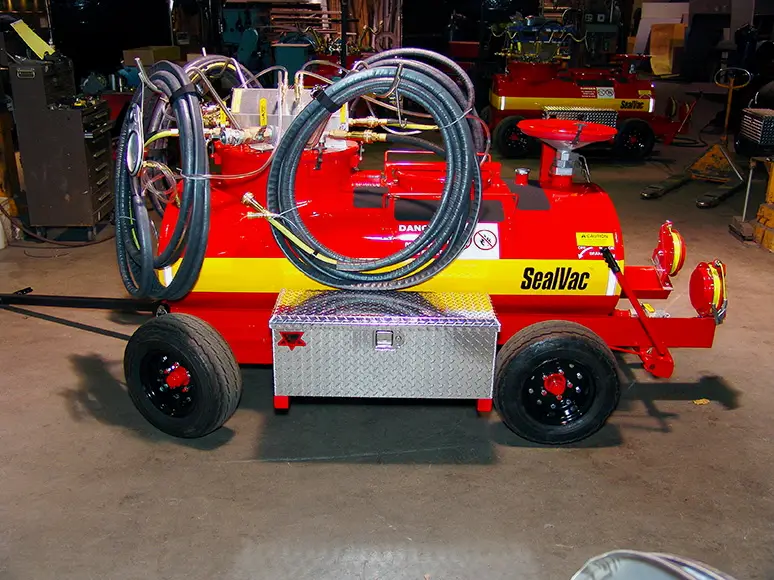
The eSealVac is built to live outdoors on the tarmac full-time, and the details reflect that. Hose rails with J-hooks hold suction plates and accessories within reach of an operator. A utility box with a foam insert keeps tooling in place instead of loose in a bed. An 18-inch manway gives access to the tank. Controls are a single three-by-two pushbutton console. That is what defines single-operator: one person, one panel, no second set of hands needed to run an extraction.
Our equipment is designed to be tactical improvement for maintenance operations. No air supply to arrange, no air line to run, no setup routine between parking it and using it. Normal fuel-handling best practices still apply, so bonding, grounding to an approved point, and eventually offloading the recovered fuel are all still critical operations.
Where the eSealVac Fits the SealVac Lineup
The concept of the eSealVac is the same as what the SealVac proved on major fleets: sealed vacuum extraction with filtration is the best way to defuel equipment.
Where compressed air is already available, the air-driven models remain the right choice. They are proven, mechanically simpler, and run on infrastructure you have already paid for. If you are weighing capacity, mobility, and fuel compatibility across the range, our guide to selecting the right aircraft fuel bowser covers the factors that matter.
So the eSealVac is an extension of our existing lineup, reaching locations where vacuum defueling meant towing a compressor or not happening at all.
Bring the Capability to the Aircraft
For most of the history of vacuum defueling, the capability had a footprint that was tied to where the air supply ran, and airframes parked outside that footprint aren’t defueled at all, or got gravity defueling, along with the hours and the fuel loss that come with it.
Operations that used to choose among gravity or towing a compressor now have a fourth option: it tows behind one truck.
Tell Us About Your Flight Line
Give us the aircraft, the location, and the tempo of your work and we’ll help you determine which product best fits your unique operational needs.
The eSealVac is built to FAA, DoD, and NATO requirements. If your operation needs vacuum defueling capability without compressed air infrastructure, a procurement path exists through Spokane Stainless Technologies.
Request a spec sheet or talk to an expert to get started.
Frequently Asked Questions
Can you defuel an aircraft without compressed air?
Yes. Conventional vacuum defueling systems generate suction with compressed air, which means either facility shop air or a towed compressor. A fully electric fuel drain bowser generates vacuum from onboard battery power instead, so it needs no air supply at all. The eSealVac from Spokane Fueling Technologies runs its vacuum pump, transfer pump, and controls on four 12-volt batteries wired into a 24-volt system, which makes vacuum defueling possible at remote airfields, detachment sites, and forward-deployed locations.
What is an electric fuel drain bowser?
An electric fuel drain bowser is a mobile aircraft defueling cart that produces vacuum suction from onboard electrical power rather than compressed air. It carries its own batteries, vacuum pump, fuel transfer pump, filtration, and collection tank, so it operates without a facility air supply or a separate compressor. The category exists to bring vacuum defueling performance to locations where crews would otherwise fall back to slower gravity draining.
What is the difference between the SealVac and the eSealVac?
Both use the same sealed vacuum extraction method, but they are powered differently. SealVac and SealVac Plus run on compressed air, requiring 60 CFM at 100 PSI, and are the right choice wherever that air supply already exists. The eSealVac is fully electric and self-contained, drawing on four onboard 12-volt batteries in a 24-volt system with a 200-watt solar panel that keeps them topped off between uses. The eSealVac reaches locations where compressed air is not practical.
How much faster is vacuum defueling than gravity draining?
Spokane Stainless Technologies publishes drain rates up to twenty-four times faster than gravity for the SealVac line, with four sumps able to be drained at once. Documented customer results include a major carrier reducing Airbus A330 fuel sump time from 14 hours to 2, and RAAF Base Richmond reducing C-130 tank venting time from 3 days to 2 hours after tank opening. The gain comes from reaching residual fuel behind the baffles that gravity cannot pull. Actual results vary by aircraft type and tank configuration.
Does the eSealVac need shop air or facility power to operate?
No. The eSealVac requires neither compressed air nor a facility power connection to run. Four Optima BlueTop 12-volt batteries feed a 24-volt system that powers the Becker VT 4.8 vacuum pump, the Fill-Rite NX25 transfer pump, and the control console. A 200-watt monocrystalline solar panel keeps the batteries topped off while the unit sits parked. Normal fuel-handling practices still apply, including bonding and grounding to an approved point, and the batteries still require conventional charging on heavy-use days.
What are the eSealVac’s tank capacity and pump ratings?
The eSealVac has a 600-gallon, double-walled stainless-steel collection tank. Its Fill-Rite NX25 transfer pump is rated at up to 25 gallons per minute on continuous duty, which is the rate at which fuel moves through the pump, not a guaranteed extraction rate from an aircraft. Vacuum comes from a Becker VT 4.8 oil-free rotary vane pump rated at 25.1 inches of mercury with 5.7 CFM of displacement. An SST-fabricated cyclone assembly removes foreign object debris and particulates at the inlet.
How does vacuum defueling protect the aircraft fuel cell?
The eSealVac includes a vacuum governor that limits the suction applied to the aircraft, as well as an automatic fail-safe shutoff. Suction limiting is standard practice on vacuum defueling equipment because unrestricted vacuum can draw a fuel cell below the pressure its vent system is designed to relieve. Equipment-side limiting does not remove the operator’s responsibility to confirm the aircraft’s tank vents are clear before extraction, which is a step in the aircraft maintenance manual rather than the cart.
Why does recovered fuel quality matter in aircraft defueling?
Fuel drained through open transfers picks up water and debris, and every additional transfer is another opportunity for contamination. Contaminated fuel ceases to be a reusable asset and becomes dirty fuel that must be stored, hauled, and disposed of. Sealed vacuum extraction keeps the path from sump to collection tank closed, and inlet filtration removes debris, so less degradation happens on the way out of the wing. Final disposition still depends on your own fuel quality control process, including water separation and testing.
What kinds of operations need self-contained defueling equipment?
Self-contained defueling equipment suits any operation requiring vacuum defueling without an air supply. That includes forward-deployed military locations, remote airfields and detachment sites without permanent shop air, hangars where distance or layout makes running an air line impractical, and operations that stage equipment outdoors between uses. The alternative has historically been gravity draining, which is slower and leaves residual fuel in the wing, or towing a compressor as a second machine.